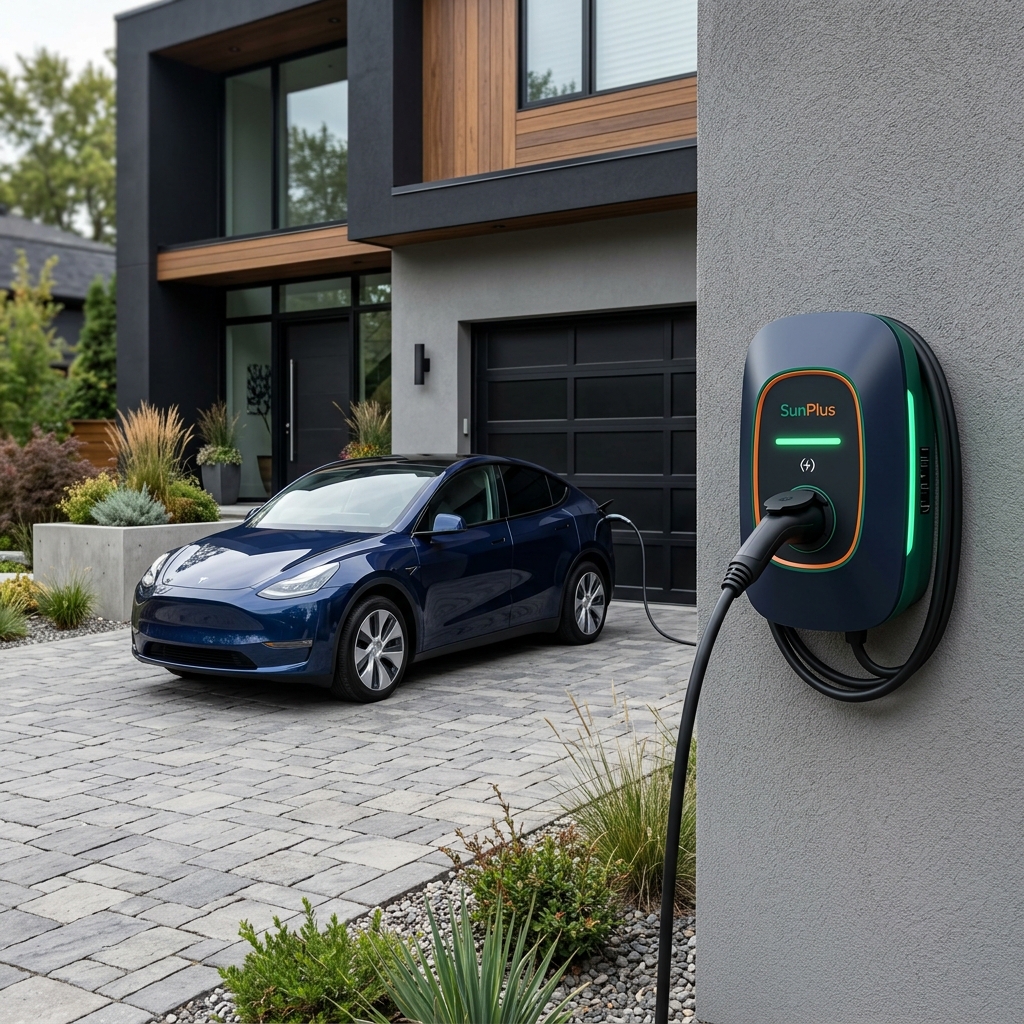
Gujarat residents should not assume that buying a home EV wallbox automatically attracts a government rebate. The state's earlier EV policy provided incentives for eligible electric vehicles and support for a limited number of public charging stations, but a charger installed exclusively in a private bungalow or allotted residential parking space is a different category.
As of 2026, the safest planning assumption is that the homeowner will fund the charger, electrical protection, cabling, earthing, and any sanctioned-load enhancement unless a current government resolution explicitly confirms otherwise. Policy windows can be extended or replaced, so verify the active notification before relying on old advertisements or social-media claims.
Previous Gujarat EV policy provisions discussed capital support for eligible public charging infrastructure. That does not automatically make every wall-mounted charger eligible. A private residential charger normally serves one household, is not continuously available to the public, and operates through a domestic electricity connection.
The four-year Gujarat EV Policy 2021 was originally introduced from July 2021. Benefits advertised under that policy should not be treated as indefinitely available. Applicants must check whether the relevant incentive has a valid extension, remaining allocation, application portal, approval process, and commissioning deadline.
| Incentive or saving | Does it normally cover a private wallbox? | What to verify |
|---|---|---|
| Electric vehicle purchase incentive | No, unless charger cost is expressly included | Vehicle eligibility, registration date, price limits, and active policy |
| Public charging station capital support | Generally no | Public access, approved location, application status, and commissioning rules |
| DISCOM load enhancement | Not a subsidy | Deposit, service-line work, meter capacity, and recurring charges |
| Automaker charger package | Sometimes covers hardware | Installation distance, accessories, civil work, and exclusions |
| Apartment society support | Depends on the society | Common infrastructure, parking rights, billing, and load sharing |
A residential AC wallbox may cost approximately ₹25,000 to ₹80,000, depending on output, connectivity, access control, weather protection, and safety functions. Installation can add roughly ₹8,000 to ₹40,000. Long cable routes, trenching, a new distribution panel, meter relocation, three-phase conversion, or sanctioned-load enhancement can increase the total.
Instead of treating subsidy as guaranteed, compare the complete installed cost. A compatible Servotech AC Charger can provide controlled residential charging, but product selection should follow a site survey and vehicle compatibility check. Buying a 22 kW unit offers no charging advantage if the car accepts only 7.4 kW AC or the home lacks suitable three-phase capacity.
For national charging-infrastructure rules and policy updates, consult the Ministry of Power. State and DISCOM requirements may add site-specific procedures.
A subsidy, even if introduced, would not replace electrical approval. Add the charger's maximum demand to major simultaneous loads such as air-conditioning, water heating, pumps, and cooking equipment. If the result exceeds the sanctioned load, apply for enhancement rather than relying on informal wiring changes.
A 3.3 kW charger is often workable for low daily driving, while 7.4 kW is a common overnight option for larger batteries. An 11 kW or 22 kW installation generally needs three-phase supply, adequate cable capacity, and vehicle support. Smart load management can reduce peaks, but it must be engineered correctly.
Homes with persistent voltage fluctuation may require an electrical assessment before adding a large continuous load. A correctly selected servo stabilizer may help in specific installations, but it is not a substitute for proper supply capacity, protection, or earthing.
Apartment residents should secure written permission before routing cables through common areas. The proposal should identify the parking space, cable path, meter source, protective devices, billing method, and responsibility for maintenance. When several residents plan to charge, a shared panel with dynamic load management can be safer and more scalable than multiple uncoordinated circuits.
A society charger accessible to visitors or multiple paying users may fall into a different regulatory or tariff category than a private charger. Classification must be confirmed before expecting public-infrastructure benefits.
Plan the project on its unsubsidized installed cost, then treat any officially approved assistance as an upside. This prevents delays, unsafe cost cutting, and purchases based on expired policy claims. Ask SunPlus Technologies for charger sizing, site assessment, protection planning, and documentation support. The best residential charging investment is not the largest charger or the biggest advertised rebate—it is a compliant system that matches the vehicle, daily travel, available load, and parking environment.
A dedicated statewide capital subsidy should not be assumed for a wallbox used privately by one household. Earlier Gujarat policy support focused on eligible EV purchases and a limited number of public charging stations. Residents should check the latest government resolution and DISCOM circulars before ordering equipment.
Normally no. A charger in a private parking space for personal use does not automatically qualify as a public charging station. Public accessibility, technical standards, registration, commercial arrangements, policy validity, and application approval may be required.
Not necessarily. A vehicle incentive and a charger installation incentive are separate benefits. Even when a manufacturer supplies a portable charger or wallbox with the vehicle, wiring, earthing, protection devices, load enhancement, and civil work may remain the owner's responsibility.
Connect with our expert engineering cell for load calculation, subsidy verification, and custom quotation.
Request Site Survey